


Strikeman
Strikeman USA, Inc.
I approached Strikeman as a practical firearm-training game rather than a conventional sports title. Its purpose is fairly focused: it supports practice around shooting technique, using a phone-based experience instead of asking you to treat the app like an arcade game. That distinction matters from the first session. You are not opening it for a story, a collection of characters, or a long list of unrelated activities. You are opening it because you want a more structured way to practise.
My overall impression is positive, with an important condition: the app makes the most sense when it is used alongside responsible, supervised firearm handling and a suitable training setup. It can give a practice session more shape, but it is not a substitute for qualified instruction, safe range procedures, or real-world judgement. Within that boundary, I found the experience useful because it encourages me to think about consistency instead of treating every practice attempt as an isolated event.
How the first sessions establish a useful goal
The early goal is simple enough to understand: work on firearm accuracy and repeatable performance. That clarity is one of the strongest parts of the design. Many sports games need time before I understand what I am supposed to improve, while Strikeman points toward a specific activity immediately. I can approach a session with a narrow intention, such as paying closer attention to my sight picture, trigger control, or ability to repeat the same process.
That focus also makes the app more suitable for short practice windows. If I only have a limited amount of time, I do not need to build a team, learn a complicated control scheme, or complete a story chapter before the session becomes worthwhile. I can prepare the equipment responsibly, open the app, and use the available training structure to keep my attention on the exercise.
There is a subtle difference between having a target to hit and having a training goal. A target can make me chase a better result on one attempt, whereas a training goal encourages me to notice how I reached that result. I found Strikeman more valuable when I treated each session as a check on consistency rather than a test of whether I could produce one unusually good outcome.
Related News





That approach is especially helpful for someone who already visits a range but tends to practise without a plan. Instead of firing until the session feels finished, I can decide beforehand what I want to observe and then use the app as a framework. The app does not magically create discipline, but it makes disciplined practice easier to organise.
What progress feels like in practice
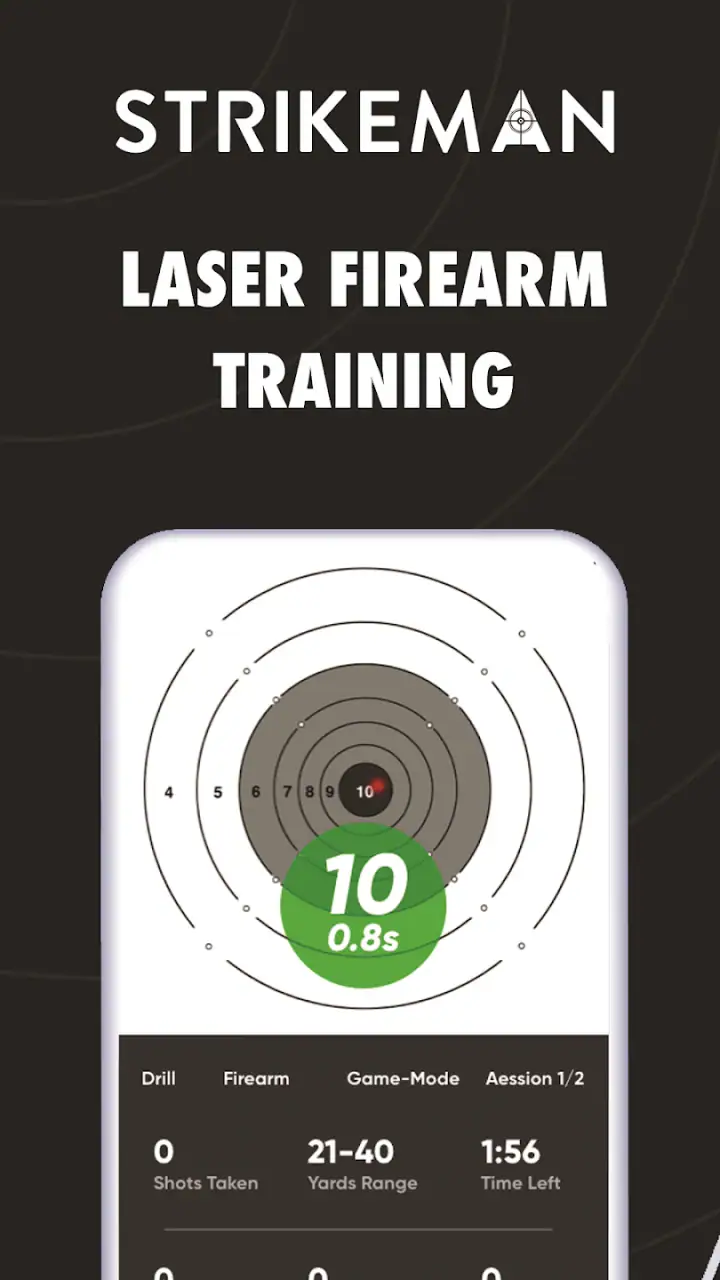
The clearest progress signal is the result of each training attempt. That sounds obvious, but it changes how I use the experience. I am not only asking whether I succeeded; I am looking for patterns. Do my results become more consistent when I slow down? Do they fall apart when I rush? Does a small change in stance or grip make my performance less repeatable? These questions turn the app from a simple shooting aid into a way of reflecting on technique.
I would not describe the progression as a deep game-style system. The appeal is not built around a large collection of unlockable content or a character improving through a role-playing structure. Instead, the progression is personal. The meaningful reward is seeing better control, more reliable results, and a clearer understanding of what affects my performance.
Gallery
That kind of progress can be easy to overlook because it is less dramatic than earning a new item or opening a new map. I had to bring my own attention to the details. A useful habit is to change only one part of the practice routine at a time. If I alter stance, pace, grip, and distance together, a better or worse result tells me very little. Keeping the session focused makes the feedback more useful.
Another practical tip is to end a session with a brief mental note about what felt repeatable and what did not. The app can support the exercise, but it cannot replace personal observation. When I use the results as a prompt for that reflection, the experience feels more substantial than when I simply chase the highest outcome.
Difficulty, pacing, and the point where the app stops carrying you
The difficulty curve is not the same as in a traditional sports game. There is no obvious fictional opponent adapting to my skill, and the challenge does not come from a campaign that steadily adds enemies or rules. The challenge comes from my own ability to maintain a controlled process. That makes the pacing slower and more deliberate, which will suit some people much more than others.
At the beginning, the main challenge is becoming comfortable with the workflow and understanding how to interpret the results. Later, the difficulty comes from trying to repeat good performance instead of relying on a single successful attempt. This is a worthwhile form of challenge, but it can feel understated if I am expecting constant novelty.
I also noticed that the app’s value depends heavily on the surrounding conditions. A rushed session, an unsuitable environment, or poor preparation can make the results less meaningful. That is not necessarily a flaw in the software, but it is an important trade-off. A conventional mobile sports game controls its environment for me; this training experience depends on real-world preparation that I must handle correctly.
For that reason, I would not use it casually while distracted or treat it as something to launch anywhere. Firearm safety has to come before convenience. I would prepare the space, follow appropriate handling rules, and make sure the practice setup is suitable before using the app. Anyone looking for a purely virtual shooting game should skip this one, because its purpose is tied to real training rather than screen-only entertainment.
Does it keep me coming back?
The retention pressure is gentle rather than aggressive. Strikeman does not need to keep me playing through a stream of fictional rewards because the real reason to return is improvement. That is a strength for focused users, but it also means motivation can fade if I am not personally interested in practising firearm skills.
I found the best rhythm was to use it as part of a repeatable routine instead of opening it without a clear reason. A session becomes more satisfying when I know what I want to work on and can compare that experience with earlier practice. Without that intention, the app may feel too narrow, especially for someone who expects a broad sports package with many modes.
The lack of a conventional entertainment loop is also why I would hesitate to recommend it as a family game, despite its Everyone content rating. The age label describes the app’s content classification, but responsible firearm training still requires adult judgement, appropriate supervision, and a safe environment. Parents should not interpret the rating as permission for unsupervised use of firearms or related equipment.
There is also a financial point to consider. The game is free to download, while optional purchases are listed from around ten dollars to around eighty dollars per item. That range makes it important to understand what you actually need for your intended setup before spending money. I would start with the free app and only consider an in-app purchase after deciding that the training workflow fits my needs.
Who benefits most from this approach
The strongest audience is someone who already has a serious interest in firearm practice and wants more structure between or around range sessions. A beginner may also find the focused format useful, but I would place safety instruction first and use the app as a supplement, not as the teacher. Someone who wants a guided lesson from a qualified professional should choose that option instead.
It is also a reasonable fit for users who dislike unstructured repetition. If I tend to practise, pack up, and later realise that I cannot explain what improved, a training-oriented app gives the session a clearer purpose. The benefit is not that it makes every attempt exciting; the benefit is that it can make practice more deliberate.
On the other hand, I would skip it if my main goal is fast entertainment. It does not offer the same kind of instant amusement as an arcade shooting game, and it is not trying to compete with a full console-style sports simulation. I would also look elsewhere if I need a complete coaching programme, detailed instruction from a human expert, or a broad set of sports activities in one app.
Compared with paper notes, the app has the advantage of putting the training activity and its feedback closer together. Compared with a conventional mobile game, it offers a more grounded purpose but less variety. Compared with a real instructor, it is more convenient and repeatable, but far less capable of correcting unsafe habits or explaining the physical reasons behind a problem. That comparison captures its proper place: it is a practice companion, not a replacement for expertise.
Practical ways I would use it
In an everyday scenario, I can imagine using it before a planned range visit to identify one specific area I want to observe. I would keep the session short and focused, then carry that goal into supervised live practice. Afterward, I could return to the app to see whether the same issue appears again. This creates a simple loop: prepare, practise, observe, and adjust.
A second useful approach is to use it when I have a gap between formal sessions but still want to maintain attention to technique. The important word is maintain. I would not treat a home session as a substitute for live-fire experience, and I would never let the convenience of a phone encourage unsafe handling. The app is most useful when it supports an existing safety-conscious routine.
A third insight is that the app works better when I resist the urge to optimise only for a score. A result can improve for the wrong reason, such as rushing through a familiar pattern without understanding it. I would pay attention to repeatability and process, then use the outcome as one piece of evidence rather than the entire judgement.
It is also worth checking the practical fit of the required setup before committing to paid content. The free download reduces the initial barrier, but optional purchases can become significant. I would first confirm that the app suits my equipment, space, and training goals, then decide whether the additional spending offers enough value for the way I practise.
Technical context and long-term confidence
Strikeman comes from Strikeman USA, Inc. and has been available since April 24, 2019. The current version is 2.1.83, and it supports devices running Android 6.0 or later. That gives it a relatively broad compatibility range for Android users, although I would still install it on the device I plan to use during practice rather than assuming every older phone will feel equally convenient.
The app has passed the early-adopter stage in the store, with over one hundred thousand installs, around one and a half thousand ratings, and an average score of 4.1. Those figures suggest a real user base and a generally favourable reception, but they do not remove the need to judge the app against my own training situation. A person seeking a narrow firearm-training tool may appreciate it more than someone browsing for a general sports game.
I also appreciate that the basic entry point is free. That makes it easier to test the workflow before deciding whether it belongs in my routine. Still, the optional purchase range means I would avoid assuming that the free download represents the complete cost of a serious setup. The sensible order is to test first, identify the exact need, and spend only when the benefit is clear.
My progression verdict
Strikeman’s goals are clear from the start, its progress signals come from improving consistency, and its difficulty grows mainly through the discipline required to repeat a sound process. Its pacing is intentionally restrained. That can feel limited beside a traditional game, but it is appropriate for a tool built around practice rather than spectacle.
The retention model is therefore personal. If I care about becoming more consistent with firearm training, I have a reason to return. If I need constant unlocks, dramatic challenges, or a large entertainment loop, the experience will probably lose me quickly. The app does not hide that trade-off; its narrow focus is both its main strength and its biggest limitation.
My recommendation is cautious but favourable. I would suggest it to a safety-minded user who wants a structured training companion and understands that software cannot replace instruction or responsible range practice. I would not recommend it as a general sports game, an unsupervised introduction to firearms, or a complete coaching solution. Used in the right context, this is a focused practice aid, not a substitute for real-world training.
For me, that is the fairest way to judge Strikeman. It succeeds when I use it to make practice more intentional, notice patterns, and build repeatability over time. It falls short when I expect entertainment, broad content, or expert correction. If that focused purpose matches what you need, the free starting point makes it worth trying before considering the optional purchases.
FAQs for Strikeman
What is Strikeman, and how does it work?
Strikeman is a smartphone-based dry-fire training system designed to help users practice shooting fundamentals without live ammunition. It generally combines a laser cartridge, a phone camera, and the Strikeman app to track shots and provide feedback. After installing the cartridge in a compatible firearm, you position the phone according to the instructions and use the app to review accuracy, timing, and training-session results.
Is Strikeman compatible with every firearm and smartphone?
No. Compatibility depends on the firearm’s caliber, model, and the specific Strikeman kit, as well as the smartphone being used. Before downloading or purchasing, check the official compatibility information carefully. The app may require a relatively recent Android or iOS device, camera access, and a suitable screen position. Some firearms, phone cases, lighting conditions, or camera placements may affect tracking performance.
Does Strikeman use live ammunition, and is it safe to use at home?
Strikeman is intended for dry-fire practice and does not require live ammunition during normal training sessions. However, users must treat the firearm as if it were loaded every time. Remove all ammunition from the training area, verify the chamber and magazine well repeatedly, point the firearm only in a safe direction, and follow local laws and the manufacturer’s instructions. The app cannot replace professional firearms training or safe handling habits.
What kind of training features does the Strikeman app provide?
The Strikeman app is focused on measurable dry-fire practice rather than entertainment alone. Depending on the kit and app version, it can offer drills, target exercises, shot detection, scoring, timing information, and session history. These tools can help users identify issues such as inconsistent trigger control, poor sight alignment, or rushed shots. Results should be treated as practice feedback, since phone-camera tracking is not a substitute for formal range evaluation.
Do I need to pay for Strikeman after downloading the app?
Downloading the Strikeman app may be free, but using the complete system normally requires compatible Strikeman hardware, such as a laser cartridge or training kit. Some features, drills, or advanced training content may also depend on the product purchased or on in-app or subscription terms. Review the current store listing and official pricing before committing, because available features, supported devices, and payment conditions can change with app updates.
Pros
- Clear visual feedback helps users understand shot placement.
- Training sessions can be completed at home with minimal space.
- Progress tracking makes it easier to monitor practice over time.
- Adjustable target distances support different skill levels.
- Useful for maintaining practice between visits to a shooting range.
Cons
- Requires compatible equipment and a suitable firearm setup.
- Phone placement and lighting can affect shot detection accuracy.
- Does not fully replicate recoil
- noise
- or range conditions.
- Some advanced features may require a paid subscription.
- Regular practice can consume ammunition and replacement target supplies.


